Liver diseases
TIPS - Transjugular Intrahepatic Portosystemic Shunt
A small tube that is inserted to connect the blood vessel at the entrance to the liver with the blood vessel at the exit.
What is it?
TIPS stands for Transjugular Intrahepatic Portosystemic Shunt. It is a small tube that is placed to connect the blood vessel at the entrance to the liver with the blood vessel at the exit of the liver.
Why this examination?
A TIPS procedure was recommended for you because the pressure in the portal vein at the entrance to the liver is currently too high. Increased pressure in the portal vein at the entrance to the liver is usually caused by the liver becoming stiffer due to scar tissue. In an advanced stage, this is called liver cirrhosis.
A cirrhotic liver with elevated pressure in the portal vein at the entrance to the liver can lead to complications such as fluid in the abdomen, bleeding from varices in the esophagus, etc. If these complications cannot be controlled with medication or other therapies, a TIPS procedure may be performed.
Because a small tube (TIPS) connects the portal vein at the entrance to the liver with the vein at the exit of the liver, the pressure in the portal vein at the entrance to the liver is reduced once again. As a result, the complications caused by high pressure in the portal vein at the entrance to the liver should improve or even disappear.
After a TIPS procedure, some of the blood will no longer pass through the liver for purification.
Preparation
- Before a TIPS procedure can be performed, your heart function must be evaluated. To do this, an echocardiogram of the heart will be performed. This is necessary because more blood will flow to the heart after a TIPS is placed. We need to be sure that your heart is still in good condition so that it can handle this increased blood flow.
- Often, a scan of your liver is also needed to visualize, among other things, new blood vessels in the abdomen that have formed because your portal vein at the entrance to your liver has been under high pressure for a long time.
- Sometimes it is necessary to assess the likelihood of confusion occurring after a TIPS procedure (see complications). You will then be referred to a neurologist for this purpose.
- You must give your explicit consent to the procedure and to receiving anesthesia in the “patient booklet” that your doctor will provide you with.
- For this procedure, you must remain fasting. This means you must not eat, drink, or smoke for 4 hours before the TIPS placement.
Medication at Home
Be sure to bring your at-home medications with you to the pre-procedure consultation. Certain medications must be discontinued before a TIPS can be placed. For example, blood thinners such as aspirin, Asaflow, clopidogrel, etc., must be stopped 5 to 7 days before the procedure.
How does it go?
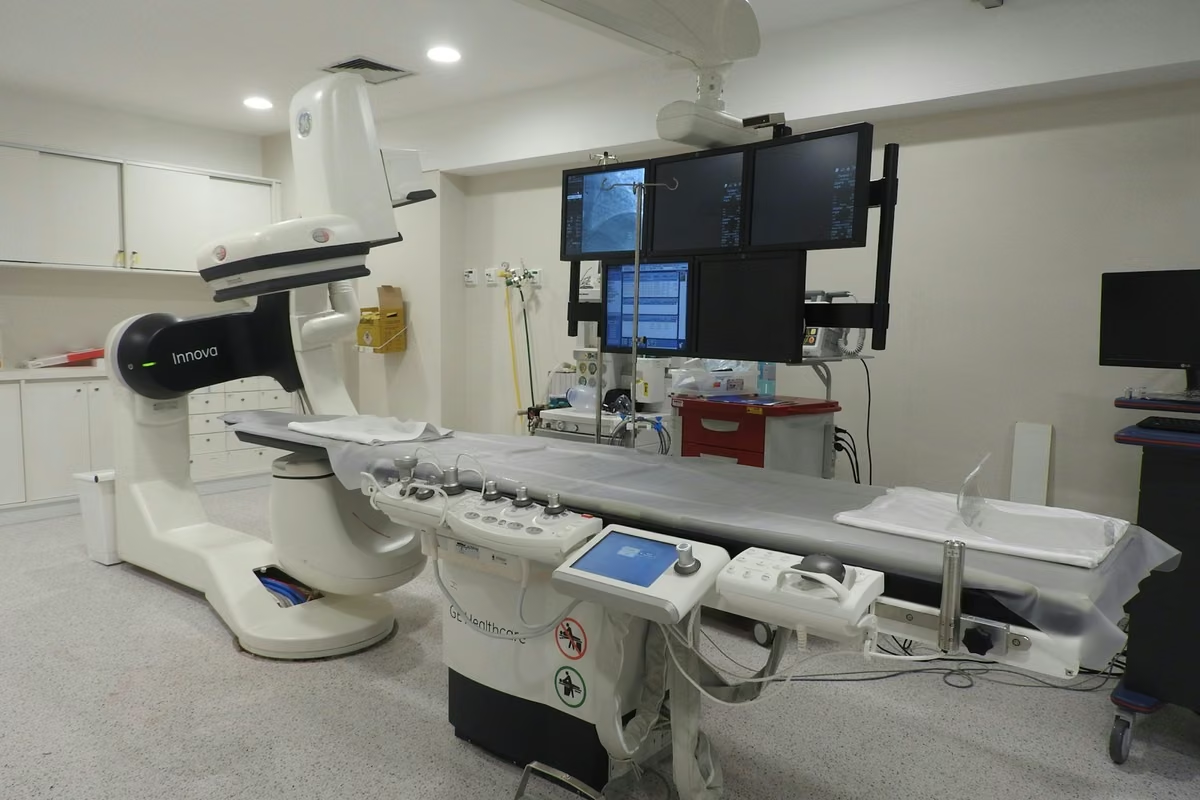
A TIPS is placed under general anesthesia and is performed by the interventional radiologist in the radiology department.
During the procedure, an access route is created through a vein in the neck. A small tube is guided along this neck vein toward the liver. Through this route, the portal vein is punctured directly through the liver tissue. To facilitate puncture of the portal vein, a small access site is often created in an artery in the groin in addition to the access site in the neck. Once the portal vein has been accessed via the neck, the pathway through the liver is widened using a small balloon that is also inserted through the neck. Finally, the created pathway through the liver is secured by placing a stent. The total duration of the procedure can vary greatly, but it typically takes about 2 hours. After the procedure, you will wake up in the hospital’s recovery room.
After the examination
After a TIPS procedure, you will need to stay in the intensive care unit for one night for observation. The day after the procedure, you will have a liver ultrasound to check your progress. After your stay in the intensive care unit, you may return to the general ward. There, you will be seen by the gastroenterologist on call; the dressing on your neck will be checked; your blood pressure, heart rate, and temperature will be measured; your level of consciousness will be assessed, etc.
If everything goes well, you’ll be able to leave the hospital again after a few days.
You’ll be given a follow-up appointment to see your hepatologist in a few weeks to check that everything is going well.
Important
When you return home:
- if there is bleeding at the injection site on the neck;
- if there is bleeding at the injection site in the groin;
- if confusion occurs;
If that's the case, consult your doctor right away.
Points of attention
If it is decided not to place a TIPS in your case (due to the patient’s choice or medical reasons), we can continue to try to manage the complications associated with liver cirrhosis (e.g., medication, paracentesis for excess fluid in the abdomen, etc.).
If you are in good overall health, a liver transplant may be an option. For this, we refer patients to UZ Leuven or UZ Gent.
Risks
During the procedure
There are some risks associated with having a TIPS implanted.
- Accidental puncture of the lungs.
- When the catheter passes near the heart, it may cause a heart rhythm disturbance at that moment.
- A hemorrhage.
After the procedure
During the recovery period, we must be vigilant for the following complications:
- Slowness and/or confusion. Because blood is no longer filtered by the liver after a TIPS procedure, certain harmful substances enter the bloodstream directly. This can lead to impaired consciousness, which may result in confusion, slurred speech, etc.
- The TIPS tube may narrow or become blocked.
- Heart failure can occur after a TIPS procedure. This is because more blood is once again flowing through the heart.
- Sometimes a TIPS is not effective enough or, conversely, is too effective. In such cases, a procedure called Transjugular Intrahepatic Portosystemic Shunt (TIPS) may be performed to adjust the TIPS. This means that the TIPS tube can be dilated or narrowed again.