Endoscopy
Enteroscopy
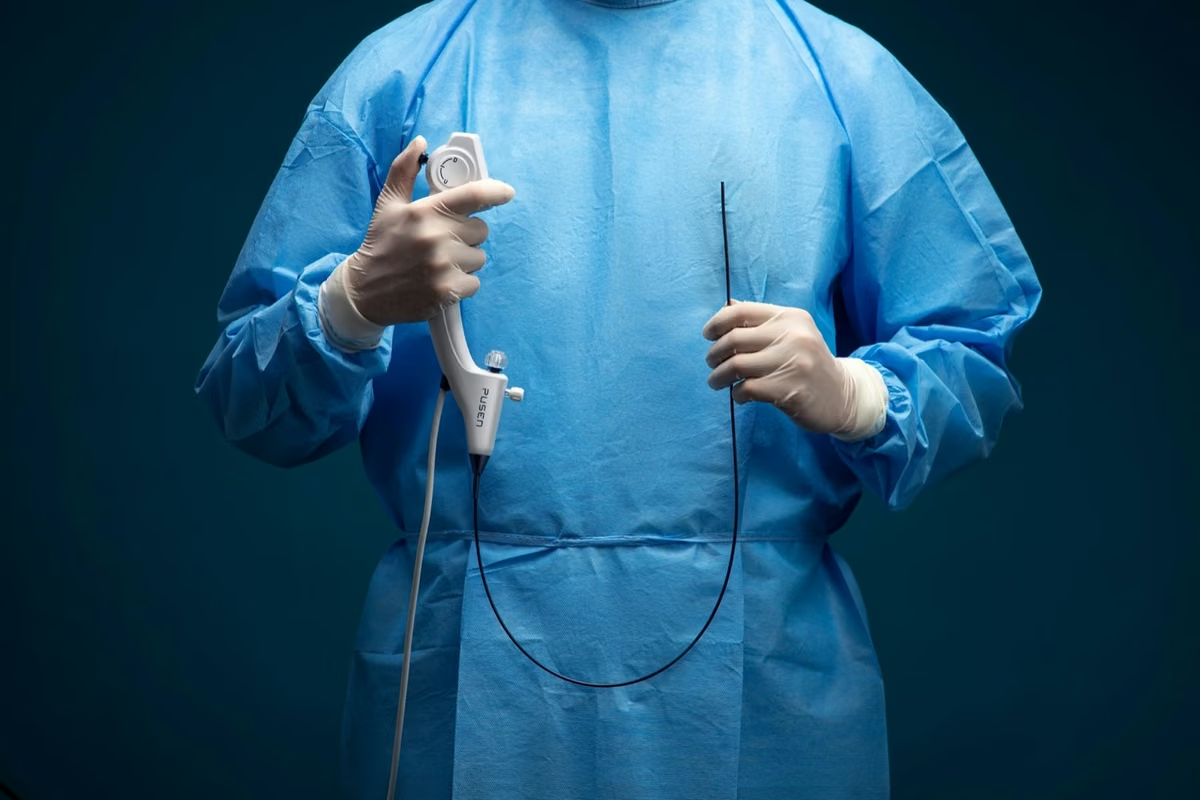
A doctor examines the small intestine using a flexible endoscope inserted through the mouth or anus to look for inflammation, polyps, bleeding, or growths and to perform treatments if necessary.
What is it?
During an enteroscopy, a doctor uses a flexible instrument (the endoscope) to examine the small intestine. This allows us to detect inflammation, polyps, bleeding, or growths. In addition, we can perform procedures using the endoscope. We can insert the endoscope through the mouth or the anus, depending on the location of the problems in the small intestine.
Preparation
You need to prepare for an enteroscopy. The specific preparation you need to do depends on whether we insert the endoscope through your mouth or your anus. Be sure to follow the preparation instructions carefully.
The following applies to both studies:
You should not take iron supplements for one week before the exam. Iron supplements turn the intestinal lining black, which makes it harder to examine the intestine. You may resume taking iron supplements after the exam.
Are you taking blood-thinning medications or diabetes medications? If so, you must inform the doctor who requested the test before the test. We will then tell you what to do about your medications before the test.
We also ask that you complete a health questionnaire for the study. You have received an email regarding this. If you do not complete the questionnaire, the study cannot proceed.
For an oral examination, the preparation is the same as for a capsule examination.
You must not eat anything after midnight.
You may still drink water or tea up to two hours before the exam. You may also take your medications with a little water up to two hours before the exam.
You must fast completely starting two hours before the test. This means you should not eat or drink anything.
For an examination through the anus, the preparation is the same as for a colonoscopy.
No X-rays of the stomach or intestines using a barium-containing contrast agent should be taken one week before the examination.
To ensure the exam is performed properly and safely, your bowel must be empty and clean. Otherwise, we might miss abnormalities or have to repeat the exam. It is therefore important that you prepare properly by taking laxatives and following a special diet. You will receive a prescription for the laxative Pleinvue for this purpose.
How does it go?
During the procedure, you will be under general anesthesia and will be lying on your left side. We will insert the endoscope through your mouth or anus. We’ll gradually advance the endoscope a little at a time to reach as far as possible into the small intestine. If we need a clearer view, we’ll blow air into your intestines through the endoscope. It’s difficult to predict how long the procedure will take. Please allow 1 to 2 hours. This also depends on the procedures we perform.
After the examination
After the procedure, you will be taken to the recovery room. Once you are fully awake, you will be given something to eat and drink. After that, you can go home with your companion. This will be about an hour and a half later. Sometimes it may be necessary to monitor you for a longer period of time.
You may feel drowsy and forgetful for the rest of the day. As a result, you are not allowed to drive for 24 hours. This means you may not drive a car, moped, bicycle, or mobility scooter. You must therefore always have someone pick you up.
Side effects
For a while after the exam, you may experience some abdominal pain, intestinal cramps, bloating, and gas. This is due to the air we blew into your abdomen during the exam. Passing gas often helps. Your throat may also be a little sore for a short time after the exam. Drinking something cold or eating ice cream helps.
Complications from this procedure are rare. The risk of a complication increases if the doctor performs a procedure during the exam. The most common complication is bleeding. Another complication is a bowel perforation, which is a small hole or tear in the wall of the bowel. We can often treat this during the endoscopy itself. Sometimes these complications do not occur until later.