Liver diseases
Liver elastography
Elastography, such as Fibroscan or ShearWave, measures the elasticity of the liver to detect damage or fatty liver. High values indicate reduced elasticity and more liver damage.
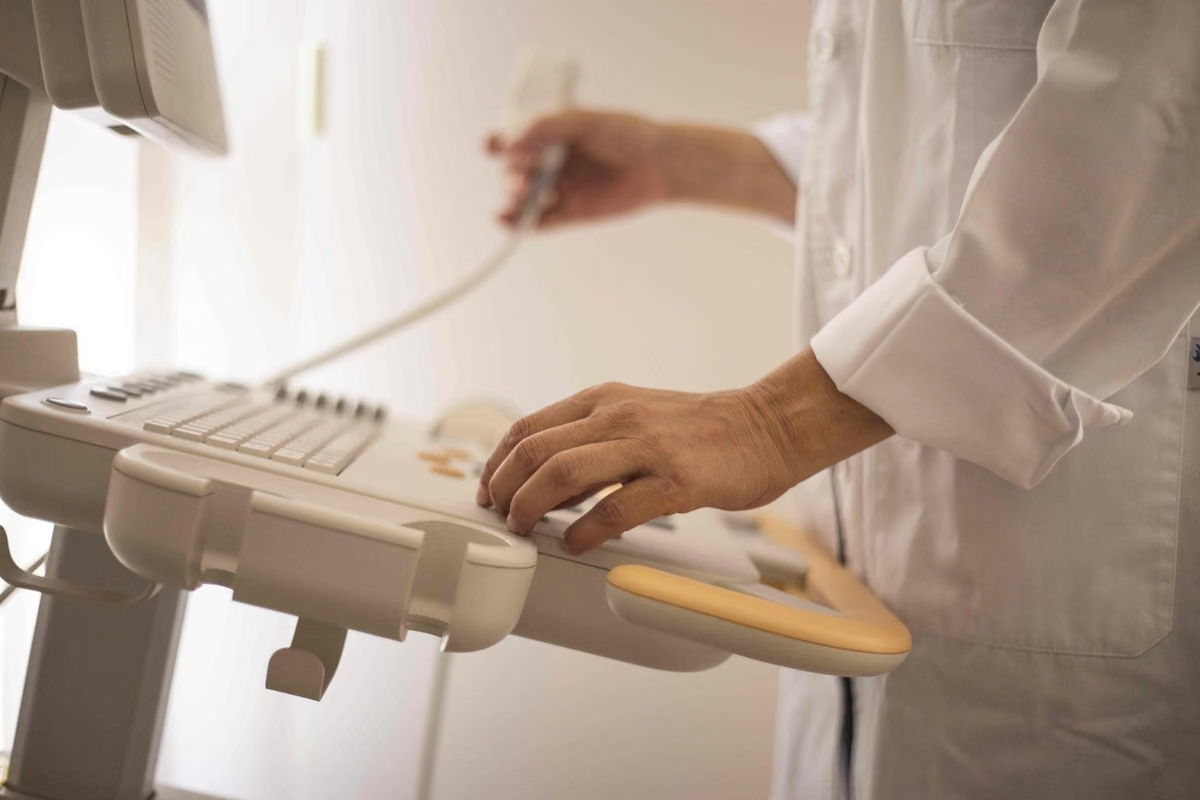
What is it?
Until recently, liver specialists (hepatologists/gastroenterologists) could only make an accurate diagnosis of liver disease through a blood test and a liver biopsy. The main drawback of a liver biopsy is that it requires puncturing through the wall of the upper body. This can cause pain and a punctured lung (pneumothorax or collapsed lung). For several years now, newer techniques have been available that allow the liver biopsy to be avoided in some cases.
Fibroscan
One way to assess liver damage is through a Fibroscan. This test measures how fast ultrasound waves travel through the liver. The faster they travel, the more damage there is to the liver and the less elastic the liver is (a high Fibroscan value of more than 12 kPa). The slower they travel, the less damage there is to the liver and the more elastic your liver still is (low Fibroscan value).
In addition to measuring liver elasticity, the Fibroscan also provides information about the degree of fatty liver. It does this using a second value: the CAP value. Because fat interferes with the ultrasound signal transmitted by the Fibroscan, the degree of “interference” with this signal is measured. A value of 250 dB/m or higher indicates fatty liver disease.
ShearWave
A second way to measure the stiffness or elasticity of the liver is through ShearWave technology. This technique uses sound waves: a specific area of the liver is marked on ultrasound images, and an elasticity measurement is performed on that area. You will also receive a value expressed in kPa. Here, too, the higher the value, the less elastic—and therefore the stiffer—the liver is, and the more scar tissue is present on the liver.
Preparation
For these tests, you must fast for 4 hours. This means you must not have eaten or drunk anything for 4 hours prior to the test.
How does it go?
The Fibroscan and ShearWave procedures are quite similar. Both tests are painless and take about 10 minutes. Both tests are performed while you are lying on your back with your right arm behind your head. You may be asked to tilt your upper body slightly to the left so that the space between your ribs on the right side widens slightly.
Gel is applied between the right ribs, and the ultrasound transducer is positioned at the level of the right rib cage. A small amount of pressure is applied between the ribs to achieve optimal visualization of the liver.
For the Fibroscan, the goal is to obtain 10 successful measurements; for the ShearWave, 3 to 4 measurements are sufficient.
Points of attention
It is possible that the Fibroscan or ShearWave may provide inaccurate results, or that the tests may be difficult to perform—for example, in the presence of ascites, a large amount of abdominal fat, etc. In such cases, a liver biopsy may still be necessary. Elastography is more of a guide, but it cannot (yet) completely replace a liver biopsy.
This test is covered by insurance only for certain conditions. If the health insurance provider does not cover the cost, the fee for this test is €30.