Liver diseases
Cirrhosis of the Liver
In short
Liver cirrhosis is the process by which healthy liver cells are replaced by scar tissue. The liver hardens and loses its functions, which can lead to complications such as portal hypertension.
What is it?
Cirrhosis of the liver means that the healthy cells in the liver are destroyed and gradually replaced by scar tissue. The liver changes from a large, smooth organ into a lumpy, hard mass.
As a result, the liver no longer functions properly and loses its functions (producing blood cells, proteins, and substances that enable blood clotting in the body; breaking down medications; removing harmful substances). As the liver becomes “stiffer,” higher pressure develops in the vascular system between the intestines and the liver (portal hypertension), which can lead to complications and often requires hospitalization.
Symptoms
In the early stages of liver cirrhosis, most patients have no symptoms.
Common symptoms of liver cirrhosis include:
- Red discoloration of the palms (palmar erythema)
- Small blood vessels in the skin form a spider-like pattern (spider naevi)
- Dilated blue veins on the abdominal wall (collaterals)
- Hand tremors (flapping tremor)
- Loss of appetite
- Lack of energy, fatigue
- A yellow discoloration of the skin or the whites of the eyes (jaundice)
- Muscle loss
Complications
- Fluid buildup in the abdomen (ascites)
- Varicose veins in the esophagus (esophageal varices) that can bleed.
- Drowsiness and confusion that can sometimes occur suddenly (hepatic encephalopathy). In some cases, this can lead to a coma. This is because the toxic substances are not being broken down sufficiently.
- Enlarged spleen due to increased blood flow to the spleen (splenomegaly)
- A blood clot in one of the veins that supply blood to the liver (portal vein thrombosis)
- Liver cancer (hepatocellular carcinoma or HCC)
- Infections
- Kidney function may be impaired (hepatorenal syndrome)
Causes
When something damages the liver, the liver tries to repair itself. This process causes scar tissue to form on the liver.
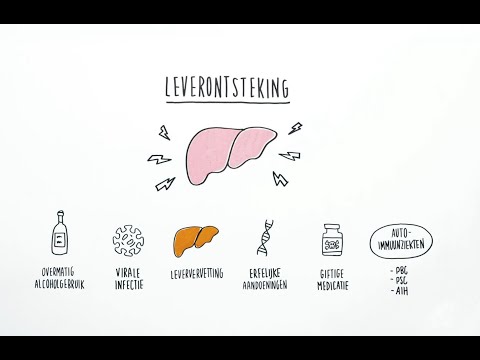
Possible causes of liver damage include:
- Excessive alcohol consumption.
People who drink a lot of alcohol or who are addicted to it are at risk of developing liver cirrhosis. - Hepatitis B and hepatitis C. (link to AZ Delta’s webpages on HCV and HBV)
These are viruses that affect the liver. You can contract these viruses at birth if the mother was infected, by sharing needles (intravenous drug use), by having unprotected sex with people who already have the virus in their blood, etc. - Fatty liver disease (NAFLD/NASH). (link to AZ Delta’s webpage on fatty liver disease)
This is a condition that occurs primarily in patients who are overweight (obese) or have diabetes. - There are other, less common causes of liver cirrhosis, such as certain hereditary diseases (iron overload disease or hemochromatosis), bile duct disorders (PBC, PSC), the use of certain medications, long-term exposure to harmful substances, etc.
Examinations
Blood Test
If you have liver cirrhosis, blood tests will be needed to determine the cause of the liver cirrhosis and to assess its severity.
The severity of liver cirrhosis can be assessed through blood tests using the following scores:
- Child-Pugh classification
This is a scoring system for patients with liver cirrhosis. Patients with liver cirrhosis are classified into three classes: Class A (score 5–6), Class B (score 7–9), and Class C (score 10–15). Patients are classified into these classes based on their functional status and the complications they have. Class C includes patients with the most severe liver cirrhosis.
This is a calculation for end-stage liver disease based on blood test results. It provides an estimate of the likelihood of death within the next 3 months for these patients. The higher the score, the higher the risk of death. The score can range from 7 to 40. When a patient has a MELD score between 15 and 20, doctors assess whether the patient is eligible for a liver transplant.
During a blood test, a small tube of blood is drawn from a vein on the inside of the arm, usually in the crook of the elbow. To make it easier to see and feel this vein, a tourniquet is tightened around the upper arm. A needle is inserted into the vein, drawing the blood into the tube. The needle is used only once and then disposed of.
Radiological Examination
Every 6 months, patients with liver cirrhosis must undergo either an abdominal ultrasound or an MRI scan of the liver. This is necessary because this patient group is at higher risk of developing liver cancer (HCC). Both an ultrasound and an MRI scan can clearly show these “lesions” if they are present.
Fibroscan
A Fibroscan is a test that measures the stiffness of the liver. The more scar tissue there is, the stiffer the liver.
A Fibroscan is a test in which a type of ultrasound transducer is placed between the ribs on the right side of the body (where the liver is located). Small shock waves are sent to the liver. The test takes about 10 minutes and is painless.
Stomach Examination
Every patient diagnosed with liver cirrhosis needs to undergo an examination of the stomach (gastroscopy). This is to detect varices in the esophagus. If left untreated, these varices can cause severe bleeding.
During a stomach examination, a tube is inserted through the mouth. This tube contains a camera and a light. This makes it easy to examine the esophagus and stomach, and allows for the treatment of varicose veins, if necessary.
Liver biopsy
A biopsy is the removal of a small piece of liver tissue for further examination. A liver biopsy is necessary when the cause of liver cirrhosis is difficult to determine, or when proof is needed for reimbursement of certain medications. There are two types of liver biopsy:
- Percutaneous liver biopsy: In this procedure, the doctor inserts a needle through the skin, between the ribs, to remove a small sample of liver tissue. (link to brochure: 0520 1180-NL)
- Transjugular liver biopsy: When there is too high a risk of post-procedure bleeding (e.g., if you are taking blood thinners that cannot be discontinued, in patients with coagulation disorders, etc.), a transjugular liver biopsy is performed. This involves removing a small sample of liver tissue through your blood vessels.
After these two biopsies, the tissue samples will be sent to the lab for further examination. You will receive the results at your next appointment, which will be scheduled shortly thereafter.
Treatment
The treatment of liver cirrhosis depends on its cause, the severity of the cirrhosis, and the patient’s symptoms. If liver cirrhosis is diagnosed at an early stage, liver function may still recover. Since liver cirrhosis is considered a chronic disease, regular follow-up visits at least every 6 months are necessary.
Treatment of the Cause of Liver Cirrhosis
Some causes of liver cirrhosis can be treated:
- Patients with liver cirrhosis caused by excessive alcohol consumption are encouraged to stop drinking.
- Patients with hepatitis C and B can take medication to eliminate the virus from the body (hepatitis C) or to suppress the virus in the body (hepatitis B).
Treating Symptoms and Complications
Reducing the Risk of Bleeding
Liver cirrhosis can cause the small blood vessels around the esophagus to swell and even “burst,” which can lead to bleeding. To prevent this, the following options are available:
- Doctors may prescribe “beta-blockers.” These are a type of medication in pill form that lower blood pressure around the liver, thereby reducing the risk of bleeding. An example of such a beta-blocker is Inderal®.
- During a stomach examination (gastroscopy), doctors can place small bands around the swollen blood vessels, preventing them from “bursting” and thus stopping them from causing bleeding.
Reducing fluid buildup in the abdomen
- Starting diuretic medication (Lasix®, Aldactone®, Burinex®, etc.) in combination with a low-sodium diet, which causes excess fluid to be excreted in the urine and reduces the amount retained in the body—and thus also in the abdomen.
- Abdominal puncture. In this procedure, fluid is removed from the abdomen by inserting a needle into the abdomen and draining the fluid.
- TIPSS (Transjugular Portosystemic Shunt). This procedure involves inserting a small tube that connects the blood vessels leading to the liver with the blood vessels draining from the liver. This effectively “bypasses” the liver.
Treating or Preventing Infection
People with liver cirrhosis are at greater risk of infection, and when they do get an infection, they become sicker than patients without cirrhosis. As a result, these patients often need antibiotics. We recommend that these patients get the following vaccinations to prevent severe infections:
- Annual Flu Vaccination
- Get vaccinated against pneumonia (pneumococcal disease) every 5 years
- Hepatitis B Vaccination
Treating Confusion
Lactulose (Bifiteral®) or rifaximin (Targaxan®) can be started to reduce the patient’s confusion. These medications are covered by health insurance.
Diet
Patients with liver cirrhosis have different nutritional needs: malnutrition must be prevented, muscle mass must be maintained, etc. You can find a brochure with information on this topic here.
Liver Transplant
If there are no other options left, a liver transplant may be considered. For this, we refer patients to UZ Leuven or UZ Gent.
Prevention
You can reduce your risk of liver cirrhosis by taking the following steps:
- Seeking Help for an Alcohol Addiction
- Get vaccinated against hepatitis A and B (there is no vaccine for hepatitis C yet)
- Use clean needles when injecting drugs. For this, you can go to the MSOC in Roeselare, for example.